The earliest history we have of Christ Church was written in 1939 by Miss Majorie Allan, which lists the church’s first organists and choir directors as follows:
F.J. Painton was the first organist. Mrs. Emily Broad, now of New Westminster, assisted him on occasion.
1891 – Miss Kate Sterling: Organist; Mr. Darg: Choirmaster (till 1896).
1894-1896 – Miss Louise Edwards: Organist.
1896-1897 – Mr. Adolph Gregory: Choirmaster.
1896-1897 – Miss Reed was organist. Mrs. Herbert Beeman, the daughter of Mrs. Machin, was substituting organist many times. Mrs. Machin was choir mother for 27 years.
It is striking how many of these organists were women. In Victorian society learning music was an important part of the education of a middle or upper-class woman, indicating her refinement and accomplishment. One can speculate that in Vancouver’s early days the majority of those possessing musical training were women, rather than the explorers/pioneers/settlers who came seeking their fortune. Whatever the reason, and noting that October is Women’s History Month in Canada, this article will recall and recognize these pioneering organists who laid the foundations for worship at CCC.
Actually, our first subject isn’t even on this list. Fanny McCartney (1852-1910) was the wife of Allan McCartney, an engineer who came to the Hastings Mill but subsequently branched out into architecture. When St. James’ Church was founded in 1881 it was Allan who designed the building and Fanny was organist and trained the choir for the opening service. Seven years later the McCartneys helped the new congregation which began meeting in the Durham Block (720 Granville, now the Starbucks next to London Drugs) on 23 December 1888. The following day it was Allan who proposed the name ‘Christ Church,’ duly unanimously accepted. In April 1889 the Weekly News Advertiser noted that Fanny had presided at the organ since the church began and was presented “with a handsome timepiece and a prayer book as a slight token of their appreciation of her services which were undertaken at great inconvenience to herself.” [The McCartneys lived two blocks east of the current St. James’ location, so getting to Georgia and Granville on a Sunday morning was a considerable journey for them.]
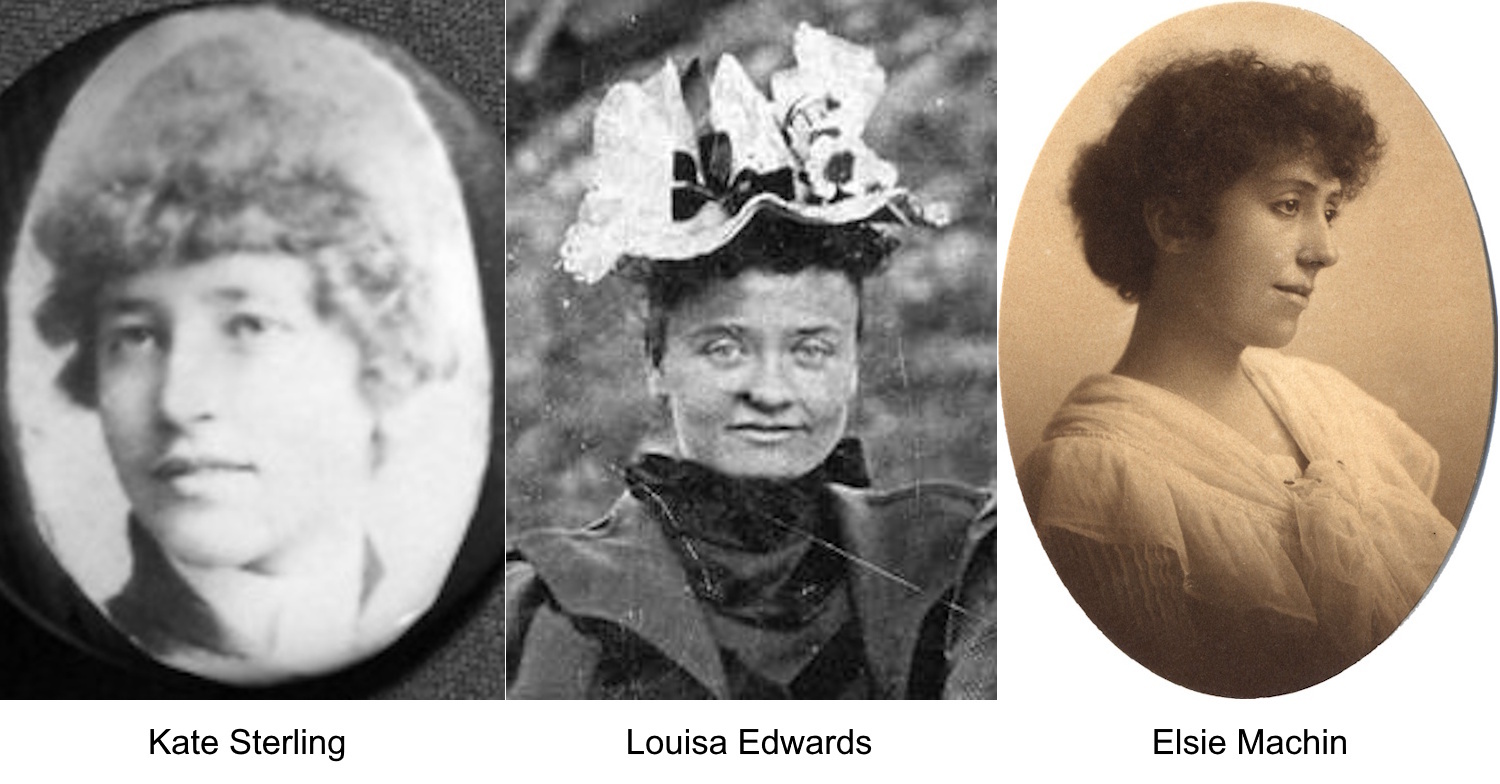
Born in Manchester, Emily Bowers (1864-1941) married butcher Frank Broad soon after arriving in BC in 1889. She is mentioned as assisting at the organ at Christ Church, also as a pianist in local entertainments, but the couple soon moved to New Westminster where they were long-time members of the choir at Holy Trinity Cathedral. Kate Sterling (1872-1934) came to BC from Bruce Mines, Algoma as part of Railway Agent David Sterling’s large family. Records from this period are sparse and incomplete, but we know from a minute book that Kate resigned as organist in 1892, implying that she held an official position rather than just acting as an occasional substitute.
Of Louisa Catherine Edwards (1868-1943) we know considerably more. Born in Ontario, she also came to Vancouver with her parents and siblings - her brothers George and Edgar operated one of the first professional photography studios in the city. Listed as a music teacher in city directories, Louisa was already playing the organ for the Christ Church Young People’s Society as early as October 1891; by June 1893 the Wardens had appointed her organist of the church as a whole. A previous article on Mrs. Machin mentions Louisa’s experience playing at the 1894 laying of the cornerstone in the pouring rain. She left her position at Christ Church in 1895 and became organist at St. Andrew’s Presbyterian. In later years Louisa taught music at the Anglican Theological College at UBC (which eventually became part of VST).
Born in Normanby, Ontario in 1873, Bertha Rubena Maud Reid was a music teacher and organist at Knox Presbyterian Church in Calgary for two years before relocating to Vancouver in the fall of 1895. She was appointed to take charge of Christ Church’s first pipe organ and was part of the inaugural concert celebrating the new instrument on 16 December 1895. Sadly, she was already suffering from tuberculosis (she had moved to the coast in an effort to improve her health) and over time was increasingly unable to cope with her duties. By July 1896 Bertha had resigned and was succeeded by Walter Evans; she died in Mount Forrest, Ontario at the end of January 1897, two weeks before her twenty-fourth birthday.
Janet Elsie Machin (1874-1968) was the daughter of ‘Choir Mother’ Eliza Machin and also sang in the choir herself. She too was an organist for the Young People’s Society and substituted when needed. Apart from church life the family were involved in benefit concerts and local productions of Gilbert and Sullivan. Despite the implications of our initial list Elsie did not marry Herbert Beeman until 1904 by which time she had left Christ Church; the couple was one of the families involved in the founding of St. Mary’s Kerrisdale in 1911. While not directly relevant to Christ Church, we have a 1951 account by Elsie of the early days of St. Mary’s, detailing one potential hazard for the pioneering organist: “As it was summer, we erected a large tent with a wooden floor and sides, on the land we soon acquired. I was elected organist with about four in the choir, my husband being one. I had always been ‘allergic’ to spiders and those summer mornings I realized the truth of the theory that spiders like music. As I sat at the organ, pedalling hard, to my horror I saw the long-legged garden variety running in my direction. I tried to pedal with one foot and kick out at the spiders with the other! As I was in full view of the congregation, I knew they wondered what on earth was the matter with me. I had a lot of explaining to do later.”
Stephen Wright