WE ARE ALL IN THIS TOGETHER — WEEK FOUR

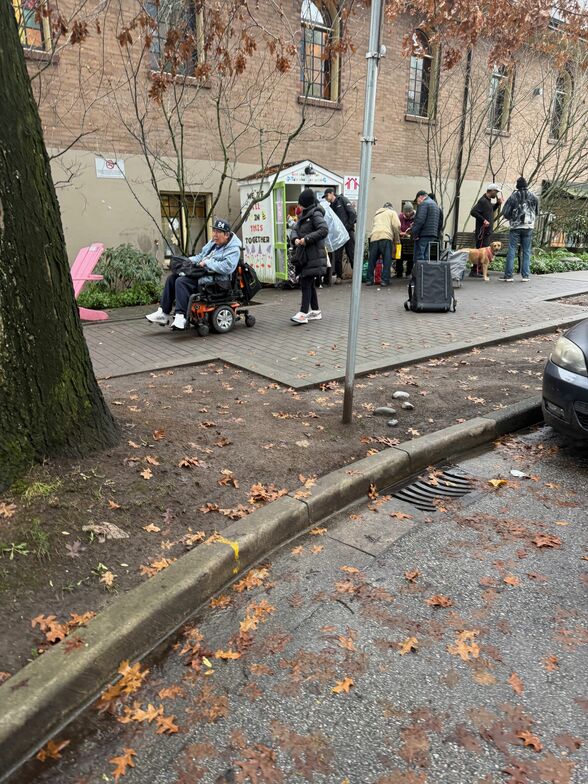
This week at the pantry, I saw something new.
Not a trickle.
Not a handful.
But a gathering.
Midweek, as I arrived with food, there were people already there...not one, not two, not three or four, but many more. They stood around quietly, waiting. Some talking softly. Some watching the door. Some simply present, patient, hopeful.
When I mentioned it to someone later, they shook their head and said,
“7th & Vine… who would have thought? It’s such an established neighbourhood.”
Yes.
And this established neighbourhood has hungry people.
Lots of them.
They are not one type of person. Hunger rarely is.
Some are people living at or near the street.
Some are first-time or new Canadians.
Some are seniors.
Some are young mothers with children.
Some arrive on foot, others by bike, others by car.
Some come in wheelchairs or on scooters.
They come because this small pantry has become known — not as charity, but as a place where dignity is preserved and food is shared without judgement.
And it made me wonder:
How many other 7th & Vines are there across this city?
Is this pantry an anomaly — or a window?
I’ve already heard from parishioners that similar pantries exist in the West End and in White Rock. Are there more? I suspect there are.
If you know of one in your neighbourhood, I’d love to hear about it. Send me a photo and a note, and next week I’ll share what is emerging because what we are witnessing may be something larger than any one corner or community.
Why This Matters: Theologically
This work we are doing together is not accidental.
It is deeply Anglican.
William Temple — Archbishop of Canterbury during the Second World War — once said that the Church exists primarily for those who are not its members. He believed that worship, doctrine, and social action belonged together, that faith which does not touch the material conditions of people’s lives is incomplete.
Temple was clear:
A society that allows hunger in the midst of abundance is not merely inefficient — it is unjust.
That conviction lives on in the Anglican Church’s Five Marks of Mission, which shape how we live our faith in the world:
- to proclaim the Good News of the Kingdom;
- to teach, baptize, and nurture new believers;
- to respond to human need by loving service;
- to transform unjust structures of society;
- to safeguard the integrity of creation and sustain the life of the earth.
What is happening at 7th & Vine touches at least three of these directly — and, I would argue, all five. Feeding people is proclamation. It teaches something about the Kingdom. It is loving service. And it quietly questions a society where so many people are left behind.
Scripture, Here and Now
Two scriptures have been echoing in my heart this week.
The first is Micah 6:8:
What does the Lord require of you but to do justice, to love mercy, and to walk humbly with your God?
Justice, mercy, humility held together. Not sentimentality. Not guilt. But faithful action rooted in God.
The second is the feeding of the five thousand.
We often hear that story as a miracle… and it is. But before it becomes a miracle, it begins with an invitation: What do you have? A few loaves. A few fish. Not enough. Or so it seems.
Let me bring that story home.
This Sunday, across our four services, roughly 500 people will come to worship at the Cathedral. If each person brought one item of food, we would have 500 items to share this week. Five hundred small offerings. Five hundred acts of faith. Five hundred ways of saying: we will not let our neighbours go hungry.
Jesus never asks for what we do not have.
He asks for what we are willing to place in his hands.
A Gentle Challenge
So here is my invitation and my challenge to all of us.
As you come to worship this Sunday, bring one item.
Just one.
Place it in the bin.
Offer it with a prayer.
Trust that God will multiply it in ways we cannot see.
Because 7th & Vine has taught me this: hunger does not always live where we expect it. And neither does grace.
Grace appears on sidewalks.
Grace gathers around a pantry.
Grace shows up when people notice one another.
Who would have thought?
God did.
And God is calling us — quietly, persistently — to keep responding.
Let’s see what we can do.